
Apply today @ www.azstay.org.
Apply today @ www.azstay.org.
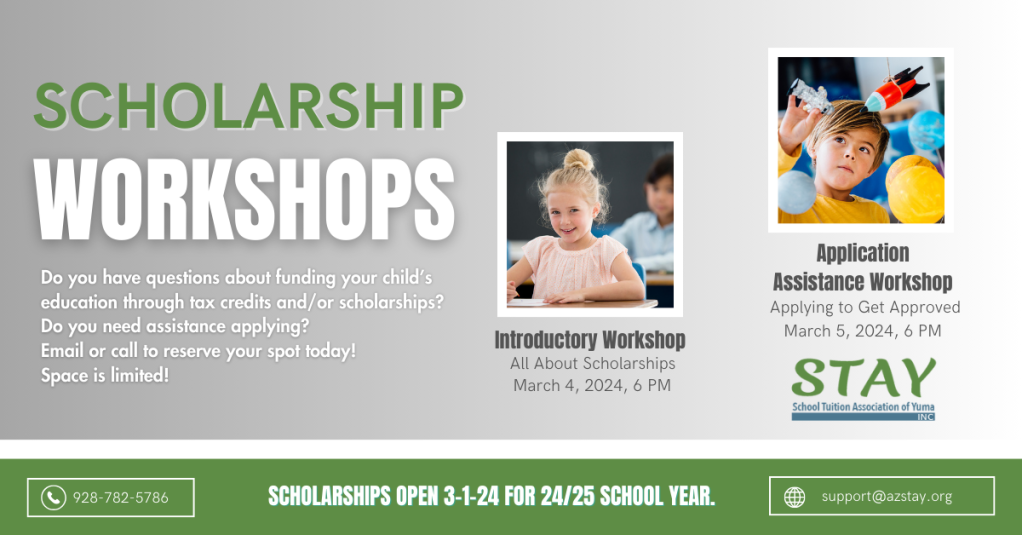


Dear STAY and other STO Families, Alumni, Students, and Supporters,
As many of you know, Governor Hobbs’ budget proposal for the upcoming 2024-2025 fiscal year could potentially eliminate Tax Credits and ESA Funding. This would be devastating to many, many families in our communities who rely on STO credits and ESA funding to provide school choice for their student(s).
You can help give these students a voice, who rely on Arizona school choice opportunities. Because, when the children in our communities thrive, we all win.
We urge you to do the following to keep School Choice available for all students:
Parents should have the right to choose how their child is educated without the cost of tuition being a barrier. Thank you for supporting School Choice in Yuma and the students that we serve at STAY!
EMMA CAMP | 1.23.2023 1:00 PM
Arizona’s newly sworn-in governor has repeatedly said that she wants to reverse the state’s expansion of its school-choice program, arguing that Arizona should instead increase funding to public schools. But the program seems safe for now.
In July, Arizona expanded its Education Savings Account (ESA) system, creating the largest school choice program in the nation. Any child who opts out of public school will receive around $7,000 per year to use toward private-school tuition, a homeschooling curriculum, tutoring, or other expenses. Previously, this funding had been available only for students who met certain requirements, such as having a disability, attending a low-performing school, or living on an Indian reservation.
“This is a monumental moment for all of Arizona’s students. Our kids will no longer be locked in under-performing schools,” then-Gov. Doug Ducey tweeted after he signed the plan into law. “Arizona is cemented as the top state for school choice and as the first state in the nation to offer all families the option to choose the school setting that works best for them.”
Hobbs doesn’t have the same warm feelings. “This voucher system we are under now doesn’t provide real choice in educational opportunity for most families,” Hobbs claimed in an October PBS interview. “It diverts resources from public schools.” In her recent State of the State address, she even argued that ESAs “will likely bankrupt the state.”
In fact, the Common Sense Institute has argued compellingly that the program will save money. While the state spends more than $12,000 per student in public schools, a typical ESA award is jus $7,000 for non-disabled students. The savings gained from reduced attendance at public schools means that “policymakers can still expect net aggregate statewide education cost savings of over $274 million,” the institute concludes.
“Opponents claim that ESAs ‘siphon’ or steal money from a student’s local public school each time a child opts for an ESA,” writes Matt Beienburg, director of education policy at the Goldwater Institute. “But in reality, under the ESA program, funding simply follows the student, just like it already does for charter and district schools via the state’s ‘open enrollment’ system.” Beienburg argues that “the financial impact to a child’s local school is virtually identical.”
In any event, Hobbs doesn’t have the votes to repeal the measure. Her budget plan defunds the program, but Republicans narrowly control the Arizona legislature and they have made it clear that they won’t accept that. (House Majority Leader Leo Biasiucci recently included attacks on school choice in a list of ideas he declared “non-starters.”) Hobbs can’t even use her line-item veto powers to defund the progran, because it is—to quote Jason Bedrick and Corey DeAngelis, writing last week in The Wall Street Journal—”funded by formula tied to money for public schools.”
That may be better not just for students but for Hobbs’ political fortunes. “A Morning Consult tracking poll this month found 67% of Arizonans and 77% of parents with school-aged children support ESAs,” Bedrick and DeAngelis note. “Enrollment has surged to 45,000 from 10,000 since the expansion. Even Ms. Hobbs should think twice before alienating these constituents.”

We would like to thank all of our donors and partner schools for sharing the goal of every child thriving, at the school of their choice, in Yuma. Our community is fortunate to have so many committed donors recognizing the importance of equal access to excellent education. Please visit our donor page here: https://www.azstay.org/corporate-donors.html and consider each of those donors for your future needs.
We hope you and your family and your businesses have an incredible New Year!
There has been much discussion lately around the Empowerment Scholarship Account (ESA) program, and unfortunately, much of it has been false. To properly understand this debate, we must understand what the ESA program is. ESAs simply allow parents to utilize their child’s education dollars toward the education model that they believe is best (for example, home-based curriculum, online learning, private school tuition, tutoring).
In other words, the money follows the student.
Last year, the Arizona Legislature passed an ESA program that allows every K-12 child to participate. This means no longer is a high-quality education reserved only for high-income families. After this monumental bill was enacted, many states across the country have modeled our law, starting a wave that is sweeping the nation.
However, instead of embracing education options, some opponents have intentionally misrepresented ESAs.
Below are the facts debunking the 5 most common myths being spread about Empowerment Scholarship Accounts.
Myth 1: ESAs will bankrupt the state
This is political rhetoric. As a former Arizona senator who helped craft 16 state budgets and served on the Appropriations Committee, I can confidently tell you that ESAs will not bankrupt the state. Let’s look at the numbers. The average total per-pupil funding for a K-12 district public student in Arizona is about $14,000 per year (this includes state, federal and local tax dollars). Compare that to the traditional ESA student who receives approximately $7,000 per year (which is derived from 90% of the state funding). This means that a typical ESA student literally receives half of the education funding they would have received if they attended their district public school. How can a program meeting the needs of only about 60,000 kids — when the overwhelming amount of state funding pays for 1.1 million other students enrolled in public schools — bankrupt Arizona?
Myth 2: There is widespread fraud.
This is not accurate and is misleading. A recent review of the ESA program by the Arizona auditor general found that less than 1% of the overall reimbursement expenses were considered “improper,” and in many of those cases it was due to parents simply not understanding the ESA guidelines. Furthermore, in most cases where there was a misunderstanding of what was an allowable education expense, the funds were returned or reallocated. This audit proves that “widespread fraud” is not being committed by parents.
Myth 3: Only wealthy parents use ESAs
This could not be further from the truth. A recent analysis of Arizona Department of Education data by the nonprofit San Juan Diego Institute shows that most of the students using ESAs live in ZIP codes that are below the average state median income. In other words, the majority of ESA students come from the poorer half of our state.
Myth 4: ESAs only help white families
We have heard this claim repeated in the media several times, but the facts show otherwise. First, state Superintendent Tom Horne stated at a press conference last month that additional bilingual staff was needed at the ESA department to address the influx of calls from Spanish speaking parents.
Additionally, a recent statewide poll commissioned in part by American Federation for Children shows the highest support for ESAs comes from Arizona’s Hispanic population with a whopping 76% in support.
Myth 5: Private schools lack accountability
This is deceiving. An in-depth survey of private schools, along with data extrapolated from Private School Review, shows that more than 96% of the most populous private schools in Arizona offer norm-referenced testing, such as the SAT, so that students in private schools can be compared to their peers. (The remaining 4% use alternative metrics). Furthermore, while some private schools choose to post testing results publicly, many others (according to surveys shared with the American Federation for Children) provide testing and academic information directly to parents via daily or weekly progress reports, so that they know exactly where their child stands academically.
In Arizona, we as taxpayers fund the student, not the system. As a state, we should stand strong against false rhetoric that threatens the freedom and flexibility of Arizona parents who are, thanks to the ESA program, successfully evaluating every education model and finding the best fit for their children.
Steve Smith is a former Arizona legislator and Arizona state director for the American Federation for Children. Reach him at ssmith@federationforchildren.org.

Charter Communications (Spectrum) presented STAY with a contribution at a recent Yuma County Board of Supervisors meeting. Charter’s contribution helps local low-income children attend private schools in the area, a choice that would not be available to them without community support. The contribution also helps by keeping money in Yuma. Thank you to Charter for being a wonderful, community-minded partner to STAY and thank you to the Yuma County Board of Supervisors for helping us recognize the great things Charter is doing for our community!
You can watch the video of the presentation here starting at minute mark 0:03:45: https://bit.ly/37TCmhY
Pictured: Darren Simmons, Supervisor District 3; Martin Porchas, Supervisor District 1; Marco A. “Tony” Reyes, Supervisor District 4; Caitlyn Pope, STAY Administrator; Michael Hadland, Charter Communications Director of State Government Affairs; Lynne Pancrazi, Supervisor District 5; Jonathan Lines, Supervisor District 3


This contribution from Misenhimer, Aivazian & Tennant, P.C. (MATPC) allowed STAY to provide scholarships to low-income children in Yuma! Without help from local businesses like this, many low-income families in our community would not be able to choose private school for their children. Thank you for helping provide School Choice in Yuma!
Pictured: Page Misenhimer, MATPC Partner; Sara Aivazian, MATPC Partner; Rex Pope, STAY Executive Director; Beth Tennant, MATPC Partner; Jeffrey Polston, MATPC Partner & STAY Board Member; Caitlyn Pope, STAY Administrator


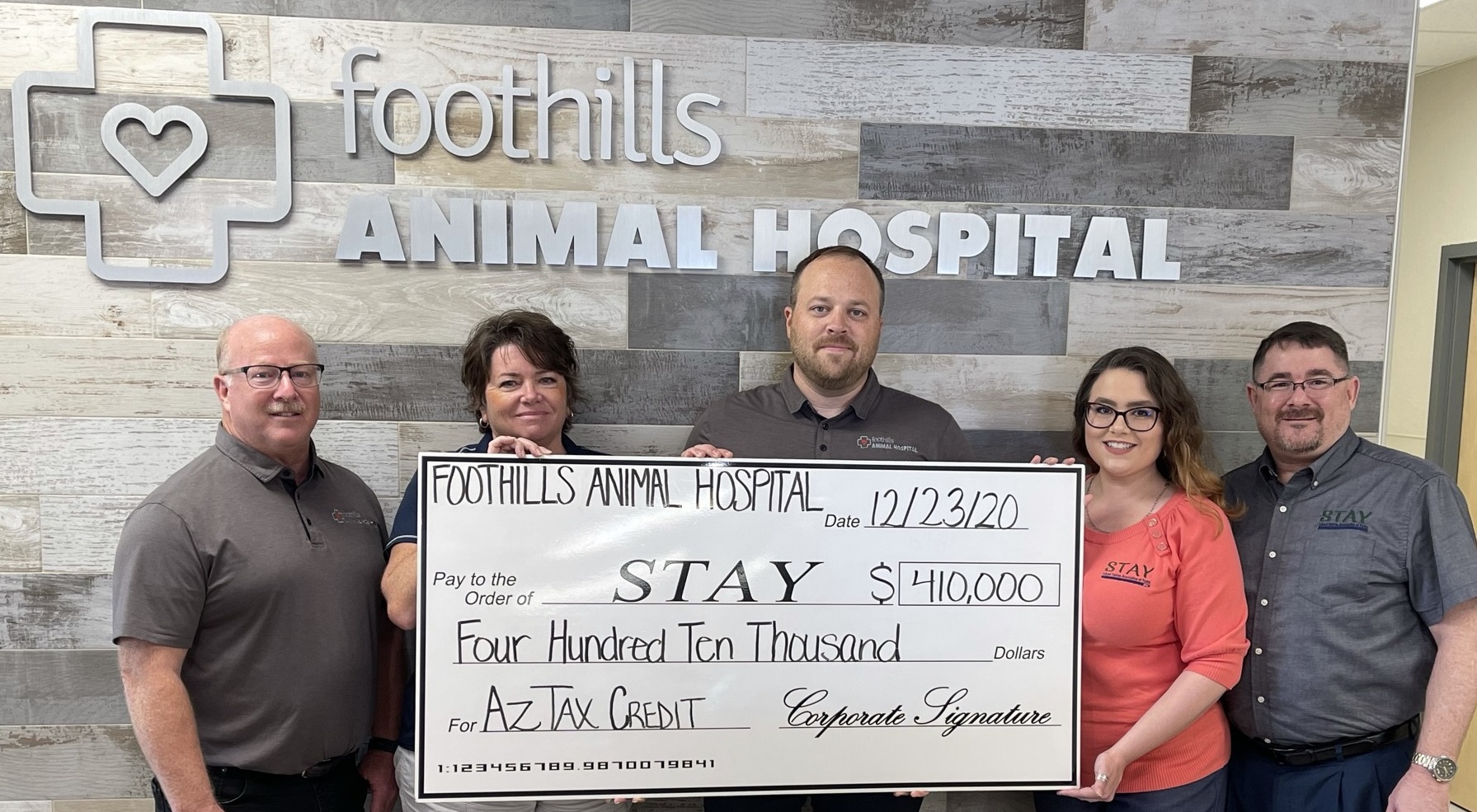
Foothills Animal Hospital’s contribution helped fund scholarships for low-income children in Yuma. Without support from community-minded businesses, many of these children and their families would not be able to afford to choose private school. Thank you to Foothills Animal Hospital for helping provide School Choice to families in our community!
Pictured: Dr. Kirk Prince, Foothills Animal Hospital; Sue Prince, Foothills Animal Hospital, Dr. Brandon Prince, Foothills Animal Hospital; Caitlyn Pope, STAY; Rex Pope, STAY
 School Tuition Association of Yuma, Inc.